
 By
By 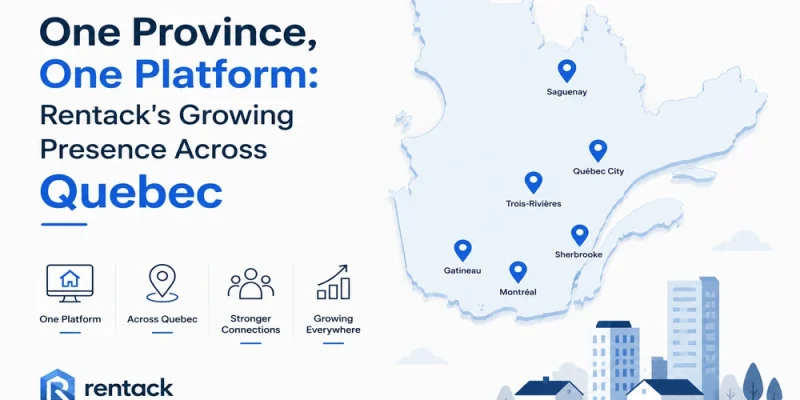
Quebec has never had a single place to look for an apartment. It has had many places – a listing site that works in Montreal, a Facebook group that works in Saguenay, a classifieds board that works if you already know which town you want, and, in a surprising number of municipalities, a paper sign taped to a window on a street you would only drive down if you already lived there.
That fragmentation is not a technology problem. It is a market problem. National and provincial listing platforms have concentrated where the density and the advertising budgets are: Montreal, Laval, Gatineau, Quebec City. Everywhere else – the mid-size cities and the small towns that make up most of Quebec’s geography – has been left to organize its own rental market, one landlord at a time.
Rentack was built to close that gap.
Why the segmentation matters now
Quebec’s rental stock is overwhelmingly owned by small landlords. Four doors, eight doors, a triplex someone inherited. These owners are not running marketing departments. When a unit comes vacant, the tools available to them are the ones within arm’s reach: a sign, a Facebook post, a neighbour who knows someone.
That worked when renters came from the same town. It works far less well now. Workers relocating for a job, families priced out of larger centres, and newcomers looking for something affordable are all searching online first – and if a municipality’s vacancies are invisible online, that municipality is effectively invisible to them. A well-priced three-and-a-half in Victoriaville or Rimouski loses out not because of the unit, but because nobody outside a twenty-kilometre radius ever knew it existed.
The cost lands on both sides. Landlords carry longer vacancies. Towns trying to attract young workers can’t show them anywhere to live.
Building provincial coverage, city by city
Rentack’s approach has been deliberately unglamorous: expand town by town rather than waiting for density to justify the effort. That means city-level listing pages for markets the larger platforms have never bothered to build, onboarding designed for landlords who don’t consider themselves technical, and AI-assisted tools that reduce leasing to something a small owner can actually manage between other responsibilities.
The platform is free for tenants, by design. Demand is the harder half of the equation in a smaller market, and charging renters would guarantee that the towns needing visibility most would never get it. Landlords pay for marketing reach and lead management – the parts that genuinely save them time and vacancy.
Bilingualism is structural rather than decorative. The same inventory, the same tools, and the same coverage are available in English at rentack.com and in French at rentack.com/fr, because a provincial platform that works properly in only one of Quebec’s working languages isn’t a provincial platform.
What comes next
The goal is straightforward: a renter anywhere in Quebec should be able to search anywhere else in Quebec and actually find what’s available. Not a Montreal platform with regional listings bolted on – a provincial platform that treats Rouyn-Noranda and Rivière-du-Loup as first-class markets.
Quebec has been segmented long enough. Connecting it is the whole point.











Comments