
 By
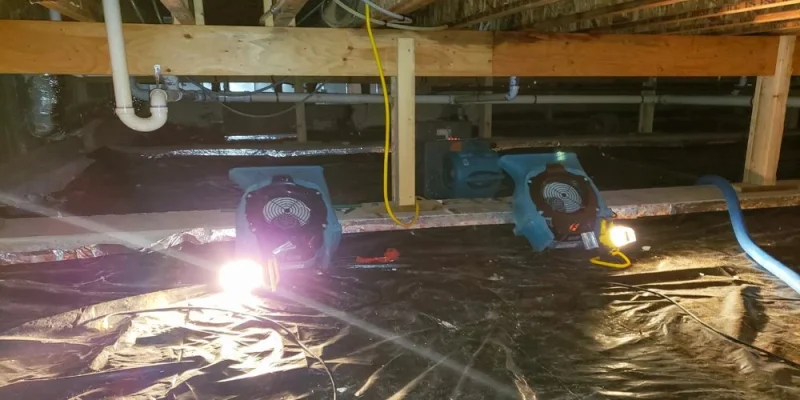
In a humid areas , sealing a crawl space is usually the right move. Closed crawl spaces stay drier than vented ones, and the research behind that is solid.
Encapsulation only works as a set, though: drainage, a sealed liner, closed vents and a way to dry the air. Leave one out and the sealed space holds moisture in.
Sealing the crawl space before fixing the water
A liner stops vapor rising from the soil. It does nothing about rain running toward the foundation or groundwater seeping in.
Middle Tennessee stacks the odds. Nashville averages roughly 50 inches of rain a year, and every downspout that dumps at the foundation sends that water toward the crawl space.
If water got in before the job, it keeps getting in after. Now it pools on top of the liner or collects underneath, in a space with no outside air to help it dry.
“Water in a crawlspace has several possible origins, and they are not interchangeable,” writes Barry Westbrook, founder of DocAir, a Nashville building diagnostics firm.
Roof runoff, groundwater, a plumbing leak and condensation each call for a different fix, and a liner handles none of them.
The DOE’s guide to closing ventilated crawlspaces puts exterior water control first in the work order and lists standing water as a reason to stop work.
Before sealing, a sound job covers:
- Downspouts discharging at least 10 feet from the house
- Soil graded to fall away from the foundation
- An interior drain and sump where groundwater can’t be stopped outside
- Plumbing and AC condensate lines that drain somewhere other than the crawl space
Closing the vents with no way to dry the air
Some jobs seal the vents, lay plastic and stop there. The crawl space can no longer dry the old way, and nothing has replaced it.
Moisture still arrives through block walls, the rim joist, and small leaks from the house above. With nowhere to go, humidity creeps up and stays.
The building code doesn’t allow that half-finished state.
IRC Section R408.3 requires a sealed crawl space to have a continuously running exhaust fan, a small supply of conditioned air, or a dehumidifier.
That drying system has to keep working, too. A dehumidifier with a clogged filter, a tripped breaker or a kinked drain hose isn’t drying anything.
A cheap hygrometer or remote monitoring catches this early. Watch for readings above 60 percent relative humidity, the ceiling the EPA recommends for indoor air.
A liner that isn’t really sealed
A sealed crawl space depends on a continuous ground liner. Under R408.3, seams overlap at least 6 inches and get sealed or taped, and the edges run at least 6 inches up the walls.
Shortcuts show up fast in a humid summer:
- Seams that are laid but never taped
- Liner that stops at the base of the wall instead of running up it
- Piers left unwrapped
- Tears from later visits by an HVAC tech or plumber that nobody patched
Every gap lets ground moisture and soil gas back in. The DOE guide calls for a final inspection specifically to catch tears before a job is signed off.
Fuel-burning appliances sealed inside
Natural-draft gas furnaces and water heaters pull combustion air from the space around them. In a vented crawl space, that air comes from outside.
Seal the crawl space and those appliances compete for a limited supply.
The risk is backdrafting, where exhaust gases, carbon monoxide included, spill into the crawl space instead of going up the flue.
The DOE guide treats a natural-draft appliance as a stop-work item.
The fix is a sealed-combustion replacement or an outdoor combustion air supply that meets mechanical code, plus carbon monoxide alarms.
Radon with fewer ways out
Foundation vents dilute soil gas along with humidity. Close them without sealing the ground well, and radon can build up.
In DOE-sponsored testing in Vancouver, Washington, radon in closed crawl spaces measured roughly 10 times the levels in vented ones, because the closed spaces exchanged far less air.
That matters in Tennessee. The state’s radon program reports that 1 in 4 homes requesting its free test kit come back above the EPA action level of 4 pCi/L.
Test before the work and again after the crawl space is closed. If a mitigation system turns out to be needed, a well-sealed liner can serve as its base.
Hiding mold, rot and termite evidence
Encapsulation covers surfaces. If mold on joists, decayed wood or active termites aren’t dealt with first, the liner and wall insulation simply hide the evidence.
The DOE guide flags framing with wood moisture above 17 percent for investigation before closing, and it lists mold on framing and signs of termites as stop-work items.
Termites deserve extra attention in Tennessee, since foam insulation run tight to the sill plate blocks the view an inspector needs.
DOE weatherization specs call for a 3-inch inspection gap between the top of wall insulation and the wood above it wherever termite pressure exists.
Signs an encapsulated crawl space is failing
- The musty smell came back, or never left
- Crawl space humidity above 60 percent for days at a time
- Water on top of the liner, or a liner that squishes underfoot
- Condensation on ducts, pipes or the inside of the wall liner
- A dehumidifier that runs nonstop, or never runs at all
- White mineral deposits creeping above the wall liner
- Hardwood floors upstairs starting to cup
What a sound encapsulation gets right
A job that holds up follows an order, and the liner comes late in it:
- Measure humidity and wood moisture, and trace where any water is actually coming from
- Fix exterior drainage and repair leaks
- Remediate mold, replace damaged wood and treat for pests
- Deal with combustion appliances and test for radon
- Seal the vents and rim joist, then install the liner to code
- Add the drying system and confirm it’s holding humidity down
- Keep monitoring through the first full summer
If your sealed crawl space still feels damp
Encapsulation earns its reputation in Tennessee when every part is in place. Skip a step and you’ve wrapped a wet problem in plastic.
If a sealed crawl space still smells, sweats or holds water, find the step that got skipped before paying for more plastic.








Comments