
 By
By 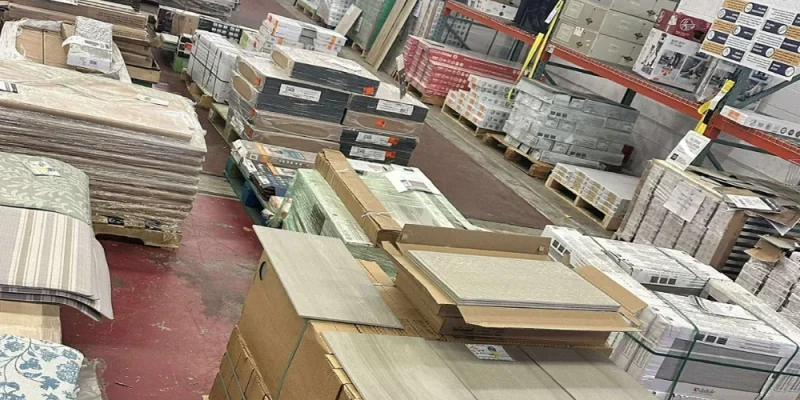
You have seen the phrase everywhere. Warehouse prices, direct-to-consumer, factory pricing. It gets thrown around so loosely that most shoppers tune it out as marketing noise. But behind the slogan sits a genuine shift in how building materials reach your home, and understanding it can save you real money on your next project. Let me walk through the questions people actually ask about it.
Why is the same tile so much cheaper at some stores?
Because the path it travels is shorter. A ceramic tile made in the same Spanish or Italian factory can reach two different stores through very different routes. The traditional route runs through importers, distributors, and then a retailer, each adding a margin. By the time it hits the showroom floor, the price has climbed well above the factory cost.
The warehouse model compresses that chain. Fewer middlemen, leaner overhead, and often a direct relationship with manufacturers. A retailer like the Entrepôt de la Réno warehouse operation is built on stripping out those layers, so the tile arrives with fewer hands taking a cut. The product is identical. What changed is the number of margins stacked on top of it.
Does cutting costs mean cutting corners?
Not on the product itself, and this is the part shoppers get wrong. The savings come from structure, not from quality downgrades. A warehouse operation trims its costs in places the customer never touches: smaller marketing budgets, tighter inventory management, less lavish showrooms, and bulk purchasing power that improves the buying price.
Think of it this way. When you buy a heavily marketed brand, part of what you pay funds the advertising that convinced you to buy it. The warehouse approach spends less on persuasion and more on price. You still get the manufacturer warranty, the same technical specs, the same durability ratings. The carton is the same. You simply skipped paying for the polish.
How do these stores keep prices low without losing service?
This is where the model has matured. Early warehouse retailers earned a reputation for cheap prices and zero help, forcing customers to fend for themselves in cavernous aisles. The better operators have fixed that. They pair warehouse pricing with dedicated consultants who guide both homeowners and contractors through their projects.
The service model is different, not absent. Instead of a large sales team working on commission to push premium products, you get advisors whose job is to match you with the right material for your actual use. In many cases that means a mobile showroom, delivery across a wide region, and pickup options that fit a real renovation timeline. Good service and low prices are not opposites when the cost savings come from the supply chain rather than from staffing.
Is the selection actually good, or just the leftovers?
A fair worry, and the answer depends on the retailer. The strongest warehouse operations compete on depth of range, not just price. They stock the large-format ceramics, the specialty vanities, and the flooring lines that big-box stores skip because those items do not move fast enough for a standardized national inventory.
That is often the hidden advantage. Because a specialized warehouse serves renovators specifically, it carries the products renovators want, including the ones that never make it into a general home center. So instead of settling for whatever the mass market stocks, you get access to a catalog built around real projects. The breadth is a feature of the model, not a casualty of it.
Who benefits most from buying this way?
Two groups, mainly. Homeowners running a mid-sized to large renovation, where the materials budget is big enough that shaving margins adds up to hundreds or thousands of dollars. And contractors, who buy constantly and feel every percentage point on their material costs. For both, the warehouse route turns a fixed cost into a lever they can pull.
Casual shoppers buying a single item on impulse may not notice the difference as sharply. But anyone planning a full room, a bathroom, a kitchen, or a floor stands to gain. The bigger the project, the more the compressed supply chain works in your favor, because the savings scale with the quantity you buy.
How to tell a real warehouse deal from a hollow one
Not every store that shouts “warehouse prices” actually delivers them, so a little skepticism serves you well. The tell is transparency. A genuine warehouse operation will happily explain why its prices are lower, point you to the technical specs, and stand behind the manufacturer warranty. A store using the phrase as pure decoration tends to get vague when you press on those details.
Compare the actual products, not the slogans. Take a specific tile or vanity, note its exact model and specifications, and price it in two or three places. A true warehouse advantage shows up as a consistent gap on identical items, not just a lower sticker on a cheaper-grade product dressed up to look similar. If the low price comes with a downgraded spec, that is not a warehouse deal, it is a substitution.
Pay attention to the buying experience too. Real warehouse retailers invest their savings back into range and service rather than into showroom theater. If you find deep inventory, staff who know the products, and straight answers about sourcing and delivery, the low prices are probably the genuine article. If the low prices come bundled with pressure tactics and evasive answers, be cautious. The honest version of this model has nothing to hide, because its savings come from a leaner supply chain, and that is a story any good retailer is glad to tell.
The takeaway
Warehouse pricing is not a gimmick when it is done honestly. It is a legitimate business model that removes cost from the distribution chain rather than from the product. The tile, the vanity, the flooring, they are the same items you would find elsewhere, minus the accumulated margins of a longer supply route.
So the next time a warehouse price looks suspiciously low, ask the right question. Not “what is wrong with this product,” but “what did this store cut to get here.” If the answer is overhead, marketing, and middlemen rather than quality, warranty, or service, you have found a genuine deal. Knowing the difference is what separates a smart renovation budget from an inflated one.
The broader lesson reaches past any single store. Renovation is one of the few big purchases where consumers rarely comparison-shop the way they would for a car or an appliance, and that habit costs them. Treating materials sourcing as a decision worth a few hours of research, rather than a quick errand, is what separates a controlled budget from an inflated one. The warehouse model rewards exactly that kind of deliberate shopper, and penalizes no one but the person who never bothered to look.










Comments