
 By
By 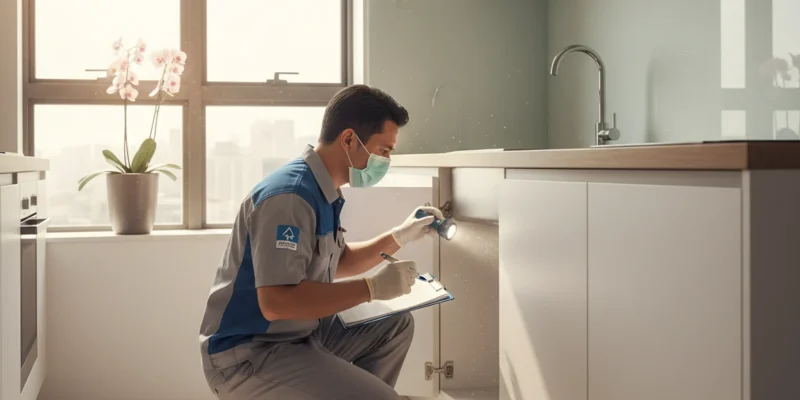
Singapore’s climate makes pest management an ongoing concern rather than a seasonal one. Warm temperatures, high humidity, dense housing, food-handling environments, gardens, drains and shared building services can all create conditions in which cockroaches, mosquitoes, rodents, termites and other pests persist.
But seeing a pest does not automatically tell you what treatment is needed.
A cockroach emerging from behind a refrigerator calls for a different investigation from mud tubes appearing beside a timber door frame. Rats moving through a ceiling void require different controls from mosquitoes breeding in a clogged drain. Bed bugs demand another approach entirely.
This is why reliable pest control in Singapore should begin with diagnosis, not simply pesticide application.
Regulation also matters. For regulated vector-control work, the National Environment Agency requires companies undertaking the work to be registered as Vector Control Operators, while personnel carrying out vector-control activities must hold the appropriate technician licence or worker certification. NEA also expects inspections, findings and treatment work to be recorded in service reports.
Singapore has also introduced SS 721:2025, its first national framework for professional pest-management services. The standard promotes Integrated Pest Management, or IPM: preventing infestations where possible, assessing risk objectively, combining different control methods and using pesticides judiciously rather than treating routine spraying as the default answer.
For homeowners, facilities managers and businesses, these developments provide a useful framework for judging a provider. A dependable service should be able to explain what pest is present, why the proposed treatment fits the problem, what needs to change around the property and how progress will be assessed after the first visit.
What “Reliable Pest Control” Actually Means in Singapore
Reliability is often described through vague promises such as “effective treatment” or “lasting results.” Those phrases are difficult to evaluate on their own.
More useful indicators are visible in how the provider works.
A structured pest-management service should normally include an inspection, identification of the pest and relevant risk factors, a treatment plan, records of work performed and follow-up where the nature of the infestation requires it.
This reflects the direction of SS 721:2025. The standard moves away from reactive chemical application towards prevention, risk-based decisions, targeted interventions and continuous monitoring.
That distinction is particularly important with recurring infestations.
If cockroaches keep returning because food debris accumulates beneath equipment, more pesticide alone will not solve the underlying problem. If rats enter through damaged service openings, trapping individuals without proofing the access route leaves the premises vulnerable to reinvasion. Mosquito fogging does little to remove larvae developing in stagnant water.
A reliable contractor should therefore be prepared to recommend environmental changes as well as treatment.
Singapore’s NEA Rules: VCO, VCT and VCW Explained
One of the most common inaccuracies in pest-control articles is the claim that every company and technician simply needs an “NEA pest-control licence.”
The actual framework is more specific.
Companies providing regulated vector-control services must be registered with NEA as Vector Control Operators (VCOs). Employees undertaking vector-control work need to be either licensed Vector Control Technicians or certified Vector Control Workers, depending on their role.
NEA states that only registered VCOs can be engaged to undertake vector-control work. The agency also advises service buyers to consider factors such as the number and experience of trained personnel, the equipment or surveillance technology used and the company’s track record.
The framework is relevant to regulated vectors such as mosquitoes, flies, cockroaches, rats and rat fleas.
It should not be casually described as one identical licensing rule covering every possible pest species and treatment method.
For customers, the practical takeaway is straightforward: where regulated vector-control work is involved, verify the provider’s current VCO registration rather than relying solely on a logo or statement displayed on its own website.
NEA’s requirements also extend beyond registration. The VCO is expected to provide comprehensive service reports and recommendations at agreed intervals, and inspection findings and treatment work should be recorded.
That makes reporting part of professional accountability, not just administrative paperwork.
Integrated Pest Management Is Replacing the “Spray and Leave” Model
The introduction of SS 721:2025 is one of the more meaningful developments in Singapore’s pest-management sector.
The standard incorporates Integrated Pest Management principles across pests including rats, cockroaches, mosquitoes, fleas, flies, biting midges, bed bugs and termites.
At its core, IPM asks providers and property occupiers to solve the conditions behind pest activity rather than repeatedly responding to visible pests.
Its main principles include prevention first, objective risk assessment, combining different control methods, reducing unnecessary chemical dependency and monitoring results over time.
That can look different from property to property.
In a restaurant, better waste management and sealing gaps around service penetrations may be as important as bait placement.
In a condominium, mosquito control may involve inspecting drains, planter areas and other water-holding locations.
In a landed home, termite management may depend on whether the infestation involves subterranean termites entering from soil or drywood termites living within timber.
A good service therefore does not necessarily use more pesticide. It uses the right intervention for the pest and the environment.
Cockroach Infestations: Look Beyond the Insect You Can See
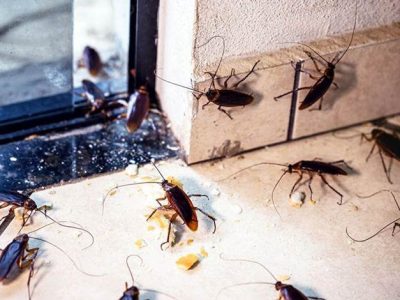
Cockroaches are among the pests most commonly associated with kitchens, rubbish areas, drains, cabinets and warm spaces around appliances.
A single sighting does not always mean there is a severe infestation, but repeated activity deserves investigation.
Signs can include droppings, egg cases, persistent nocturnal sightings and activity around food-storage or preparation areas. Heavier infestations can also produce a noticeable odour.
The key to control is finding where cockroaches are harbouring and what resources they are using.
Food residue beneath equipment, leaking pipes, accumulated grease, poorly sealed gaps and clutter can all contribute to favourable conditions.
Professional control may include targeted gel baiting, residual treatment in suitable areas, monitoring and recommendations on sanitation or proofing.
Simply applying aerosol spray to every visible cockroach may kill the insects exposed at the time without reaching hidden harbourages.
For businesses, recurring cockroach activity should also trigger a review of waste handling, cleaning procedures and storage practices. Pest activity is often a facilities problem as much as a pesticide problem.
Mosquito Control Starts With Water, Not Fogging
Mosquito treatment is another area where the most visible intervention is not necessarily the most important one.
NEA states that the most effective way to control mosquito populations is to prevent breeding. Mosquitoes can breed in stagnant water found in discarded containers, clogged drains, roof gutters, ground puddles, water-storage containers and infrequently used gully traps.
That makes source reduction the foundation of mosquito management.
Residents and property managers should regularly inspect places where water can collect and remove the water or correct the condition where practical.
Where potential breeding habitats cannot be permanently removed, NEA advises engaging a competent pest-control operator to inspect and treat them where appropriate.
Thermal fogging has a more specific role.
NEA requires VCOs to notify the agency before fogging, and its guidance for some premises states that fogging should be used where adult mosquito populations or disease circumstances justify it rather than as routine preventive spraying.
The takeaway is simple: if a mosquito programme consists mainly of repeated fogging without serious attention to breeding habitats, ask what is being done about the source.
Rodent Problems Need Exclusion as Well as Control
Rat sightings create understandable urgency, particularly in food premises or storerooms.
But rodent management should not stop with catching the animals currently present.
Rats enter properties because access, food, water and shelter are available.
Warning signs include droppings, gnawed packaging or wires, grease marks along regular routes, noises in ceiling voids and repeated sightings.
Once activity is confirmed, a programme may combine trapping or baiting with inspection of likely access routes.
Doors, pipe penetrations, drains, service openings, roof areas and wall gaps can all deserve attention depending on the premises.
Housekeeping also matters. NEA advises controlling food availability, managing rubbish, reducing clutter and sealing potential entry points as part of rat prevention.
Monitoring technology can help in some environments, especially where rodents are active in concealed areas or large commercial premises.
For example, Aardwolf Pestkare publishes pest-trending and monitoring services in which pest-count data from monitoring stations can be analysed to identify irregular activity and guide corrective action.
That is a more defensible use of technology than claiming that every sensor automatically cuts labour by a fixed percentage or increases captures by a predetermined amount.
The useful question is whether the technology produces information that changes or improves the treatment decision.
Termites Require Species-Specific Treatment
Termite activity is fundamentally different from a cockroach or mosquito problem.
The concern is property damage rather than disease transmission, and much of the infestation can remain concealed.
Possible warning signs include mud shelter tubes, damaged timber, hollow-sounding wood, discarded wings and unexplained deterioration around built-in cabinetry, skirting, doors or other timber elements.
Identifying the type of termite matters.
Subterranean termites generally maintain colonies associated with the soil and forage into buildings through concealed routes. Drywood termites live inside timber and therefore require a different management approach.
This is why one termite treatment should not automatically be presented as the best solution for every property.
Subterranean termite programmes can involve baiting, soil treatment, targeted spot treatment or combinations of these approaches depending on site conditions.
Inspection technology can also assist in selected cases.
Aardwolf Pestkare, for example, currently uses TermiCam thermal imaging to help detect suspected subterranean termite activity around built-in structures and offers baiting, soil treatment and spot treatment among its termite services.
That is a provider-specific example rather than a rule that thermal imaging is mandatory for termite inspection.
The broader principle is more important: the proposed treatment should follow the termite species, evidence found and building conditions rather than beginning with a predetermined package.
Bed Bugs: Confirm the Infestation Before Treating It
Bed bugs can cause substantial distress, but bites by themselves are not enough to confirm their presence.
NEA notes that bed bugs can hide in sleeping areas, behind wall coverings, around furniture, electrical outlets and mattresses. Detection can involve visual inspection and monitoring traps.
Importantly, bed bugs are not known to transmit diseases to humans, although their bites can cause itching, discomfort and allergic reactions in some individuals.
Treatment often requires a combination of methods rather than one universal spray.
NEA describes possible controls including vacuuming, hot laundering, steam or heat treatment, elimination of harbourages and insecticide application.
The correct combination depends on the infestation, the room and the treatment provider.
This is why promises that one identical procedure will eliminate every bed bug problem should be treated cautiously.
Ants, Flies and Other Common Pest Problems
Not every pest seen around a home or business presents the same level of risk.
Ants are often attracted by accessible food and water and may establish trails between nesting and feeding sites. Minor problems can sometimes be reduced through sanitation and suitable consumer baiting, while persistent activity may require identification and targeted treatment.
Flies are more significant around food-handling environments because they can move between contaminated materials and food or food-contact surfaces.
In commercial sites, fly activity often points back to waste management, drain hygiene, food residue or breeding material that requires correction.
This highlights a recurring point across pest categories: control works best when treatment and environmental management happen together.
When Does a Pest Problem Need Professional Attention?
Not every pest sighting requires an immediate service contract.
A few ants attracted to exposed food may disappear once sanitation and entry points are addressed. A single outdoor cockroach entering through an open door is different from repeated activity in kitchen cabinets.
Professional assessment becomes more useful when the pest activity is persistent, difficult to identify or likely to remain concealed.
Warning signs worth taking seriously include:
- repeated cockroach sightings, droppings or egg cases;
- rodent droppings, gnawing or noises in concealed areas;
- suspected termite mud tubes or timber damage;
- recurring bed bug evidence around sleeping areas;
- mosquito larvae or repeated breeding in water-holding locations;
- pest activity affecting food-handling or business operations.
The earlier these problems are correctly identified, the easier it is to develop an appropriate response.
But “earlier” should not be confused with automatically purchasing the fastest or most aggressive treatment available.
Residential Pest Control: HDB Flats, Condos and Landed Homes
Singapore’s housing types create different pest-management challenges.
HDB Flats
Pest activity in an HDB flat may be influenced by shared infrastructure.
Rubbish chutes, drainage systems, pipe routes, corridors and neighbouring units can allow cockroaches or rodents to move beyond one household.
This means repeatedly treating a single flat may have limited effect if the underlying source is in common property.
Residents should report suspected common-area issues to the relevant managing authority where appropriate.
Inside the home, sanitation, food storage, moisture control and sealing obvious access routes remain useful preventive measures.
Condominiums
Condominiums have similar shared-property considerations.
Managing agents commonly maintain pest-management programmes for common areas, but individual units can still develop localised problems.
Where residents repeatedly see pests entering from landscaping, rubbish facilities, drains, risers or other shared areas, informing the management can help determine whether a building-wide issue exists.
Landed Properties
Landed homes generally have greater exterior exposure.
Gardens, perimeter drains, accessible soil, roof gutters, outdoor storage and timber structures can create conditions associated with mosquitoes, rodents or termites.
This does not mean a landed home automatically needs routine heavy pesticide use.
Inspection, housekeeping, drainage maintenance and physical pest-proofing can play an equally important role.
Commercial Pest Management Requires Stronger Documentation
Restaurants, warehouses, offices, factories and other commercial premises have more complex pest risks than the average residence.
A food establishment may need to monitor drains, refuse areas, dry-goods storage, receiving zones, grease accumulation and food-preparation areas.
Warehouses deal with incoming stock, pallets, loading bays and large perimeters.
Office buildings may have pantry-related cockroaches or ants as well as rodent movement through shared infrastructure.
Professional commercial programmes typically benefit from:
- documented inspections;
- monitoring devices where relevant;
- treatment records;
- trend analysis;
- corrective recommendations;
- clear responsibility between the contractor and facilities team.
This last point is particularly important.
A pest-management company cannot permanently compensate for overflowing rubbish bins, leaking pipes, damaged doors or inaccessible cleaning areas.
The client also needs to correct the environmental factors identified in the service reports.
That is the accountability model SS 721:2025 supports: measure whether the pest risk is being reduced rather than judging performance by the amount of chemical used.
How Much Does Pest Control Cost in Singapore?
There is no single reliable market price for pest control in Singapore.
Costs vary because treatments themselves vary.
A small ant problem in one apartment is not comparable with a subterranean termite programme around a landed house. Bed bug treatment can change according to the number of affected rooms. Rodent work may involve multiple monitoring points and proofing recommendations. A commercial contract can cover recurring inspections, reporting and several pest categories.
Factors that commonly influence quotations include:
- pest species;
- property type and size;
- severity of activity;
- accessibility of harbourages;
- selected treatment method;
- number of visits;
- monitoring requirements;
- commercial reporting requirements;
- additional proofing or corrective work.
This is why online price guides should be treated as rough context rather than definitive Singapore-wide rates.
An inspection may be appropriate before quoting complex work, particularly for termites, rodents, bed bugs and larger commercial sites.
However, the claim that every reputable provider must offer a free inspection should also be avoided. Consultation and inspection policies vary by company.
The better comparison is the written scope.
Two quotations that appear similar in price may include very different treatment areas, revisit arrangements or monitoring periods.
The Service Report Is One of the Best Measures of Accountability
Customers often focus on the treatment itself and overlook the report.
That is a mistake.
For regulated vector-control services, NEA explicitly expects inspections, findings and treatments to be recorded, and VCOs should provide comprehensive reports and recommendations at agreed intervals.
A useful report should make clear what was inspected, what pest evidence was found, where activity occurred and what work was carried out.
Where monitoring is used, subsequent reports should help show whether pest activity is increasing, decreasing or shifting elsewhere.
For recurring commercial programmes, this trend information is especially valuable because it enables management teams to judge whether corrective action is working.
A service report should therefore be treated as part of the deliverable, not as paperwork that disappears into a drawer.
Pesticide Safety: Avoid Vague “Non-Toxic” Claims
Safety is an important consideration when pest treatment takes place around homes, children, pets or food-handling areas.
But terms such as “non-toxic,” “chemical-free” and “100% safe” are often used too loosely.
Some IPM methods genuinely avoid pesticide use in certain situations. Examples can include proofing, trapping, heat, sanitation, removal of harbourages and environmental modification.
Other programmes may use pesticides but in targeted quantities or lower-toxicity formulations.
For vector-control work, relevant pesticides must be registered with NEA. NEA distinguishes between products for general use and restricted-use products, with restricted products intended only for appropriately licensed or certified vector-control personnel.
Customers should ask the provider what product or method will be used and what precautions apply.
Relevant questions include whether food needs to be covered or removed, whether pets must be moved, whether occupants need to leave temporarily and how long treated areas should remain undisturbed.
Clear safety instructions are more meaningful than broad assurances.
Choosing a Pest Control Provider: 7 Practical Checks
When comparing pest control services in Singapore, the following checks are more useful than relying on advertisements or headline promises.
1. Verify Regulatory Status
For regulated vector-control work, confirm that the company is currently registered as a VCO and that personnel performing the work hold the appropriate credentials.
Aardwolf Pestkare, for example, appeared on NEA’s published list of registered Vector Control Operators as of November 2025. Because regulatory status is time-sensitive, customers should still confirm its current registration before engagement rather than relying on an older list.
2. Ask What Evidence Was Found
A provider should be able to explain why it believes a particular pest is present.
Where were the droppings?
What termite evidence was detected?
Where might rodents be entering?
Are mosquitoes actually breeding on site?
A diagnosis based on evidence gives you a stronger basis for evaluating the proposed treatment.
3. Understand Why the Method Was Chosen
There should be a logical connection between the pest and the method.
Termite baiting, soil treatment and localised treatment address different circumstances.
Cockroach baiting should follow information about harbourages.
Rodent trapping should be paired with investigation of access and food sources.
If every site receives the same treatment regardless of findings, ask why.
4. Review the Written Scope
Clarify the treatment areas, pests included, number of visits, exclusions and follow-up arrangements.
Do not assume that “general pest control” includes termites, bed bugs or every other pest category.
5. Check Reporting and Monitoring
For recurring contracts, ask what information will be provided after each visit and how pest activity will be tracked.
Monitoring is particularly important where infestations cannot reasonably be assessed through one inspection.
6. Ask About Safety Instructions
Request the product or method information and the precautions relevant to your household or business environment.
Avoid relying solely on terms such as “eco-friendly.”
7. Consider Relevant Experience
Length of operation does not automatically guarantee quality, but experience with the particular pest and property type can be useful context.
A provider servicing commercial kitchens regularly may have different operational experience from one focused mainly on residential jobs.
Aardwolf Pestkare, for example, states that it uses an identification-led pest-management approach and currently offers residential and commercial services, technical pest identification, trending analysis and programme reviews.
The point is not that one provider is automatically the best choice, but that buyers should compare concrete capabilities with the needs of the site.
Prevention Between Pest-Control Visits
Professional treatment works better when property occupiers remove the conditions that allow pests to thrive.
Around homes and businesses, that includes storing food correctly, cleaning spills, maintaining rubbish areas, reducing clutter and repairing water leaks.
Entry gaps around doors, pipes and service openings should be addressed where practical.
For mosquitoes, stagnant water deserves particular attention.
NEA recommends checking and removing potential breeding habitats such as containers, clogged drains, roof gutters and other places where water can remain.
Commercial properties may need more formal housekeeping procedures because a recurring issue can involve several departments.
Facilities, cleaning, kitchen and pest-management teams should not operate independently when the underlying problem crosses those functions.
The most successful treatment is usually the one supported by good site management between technician visits.
Why “Effective” Pest Control Is Better Measured by Outcomes
Traditionally, pest-control services could easily be judged by activity: how many visits took place, how much pesticide was applied or how many traps were deployed.
SS 721:2025 encourages a more useful perspective.
The standard promotes performance and outcome-driven pest management.
That means asking whether pest activity has actually fallen.
Have rat sightings stopped?
Are cockroach monitoring counts decreasing?
Has mosquito breeding been removed?
Are termite stations showing the expected changes?
Have sanitation or structural recommendations been completed?
This makes the relationship between client and provider more accountable.
A service that repeatedly applies treatment without measurable improvement should trigger questions, even if every scheduled visit technically occurred.
Frequently Asked Questions
Does Every Pest Control Company in Singapore Need an NEA Licence?
For regulated vector-control services, companies must be registered with NEA as Vector Control Operators. Employees performing vector-control work must be licensed as Vector Control Technicians or certified as Vector Control Workers as applicable. It is more accurate to use these terms than to describe the entire pest-management industry as operating under one generic licence.
How Often Should a Singapore Home Have Pest Control?
There is no universal schedule. Frequency depends on the property, pest species, surrounding conditions and whether the service is preventive or treating active infestation. Recurring pest activity should be assessed based on evidence rather than automatically placing every household on the same servicing cycle.
Is Pest Control Safe for Children and Pets?
Safety depends on the treatment method, product and precautions followed. Some programmes can rely heavily on non-chemical measures, while others require registered pesticides. Tell the provider about children and pets beforehand and follow its product-specific preparation and re-entry instructions.
Is Chemical-Free Pest Control Effective?
It can be effective for some situations, but “chemical-free” is not a complete treatment strategy by itself. Trapping, proofing, heat, sanitation and environmental modification are useful tools, while some infestations may still justify carefully targeted pesticide use under an IPM programme.
When Should I Call a Professional for Termites?
Professional inspection is sensible when you find mud shelter tubes, discarded termite wings, unexplained timber damage or hollow-sounding wood. Avoid assuming a visible spray treatment is enough, because termite activity may extend beyond the area you can see.
Does Mosquito Fogging Prevent Dengue?
Fogging targets adult mosquitoes but does not remove breeding habitats. NEA states that preventing mosquito breeding is the most effective way to control mosquito populations, which means stagnant water and other breeding sources remain the priority.
What Should a Pest-Control Service Report Include?
For vector-control work, inspections, findings and treatments should be recorded. A useful report should identify the locations inspected, evidence found, work performed and recommendations, with monitoring results where these form part of the programme.
Is a One-Time Pest Treatment Enough?
Sometimes, but not always. A minor localised problem may respond to one intervention, while termites, bed bugs, rodents and established cockroach infestations can require monitoring, repeated treatment or corrective work. The provider should explain the expected programme before work starts.
Conclusion
Reliable pest control in Singapore is less about finding the strongest chemical or the company with the most dramatic promises.
It is about getting the diagnosis right.
The provider should understand where the pest is active, select a method that fits the problem, meet applicable regulatory requirements, communicate safety precautions and provide enough reporting to show whether the programme is working.
Singapore’s move towards IPM under SS 721:2025 reinforces that approach. Prevention, monitoring, risk-based decisions and targeted interventions are becoming better measures of service quality than routine spraying alone.
For homeowners or businesses that prefer professional assessment, Aardwolf Pestkare is one established provider operating in Singapore, with published services covering residential and commercial pest management, termites and several common household and business pest concerns. As with any pest-management company, customers should confirm the current regulatory status, proposed scope, safety instructions and follow-up arrangements before proceeding.
Accountability ultimately comes down to evidence: what was found, what was done and whether pest activity actually improved.





Comments