
 By
By 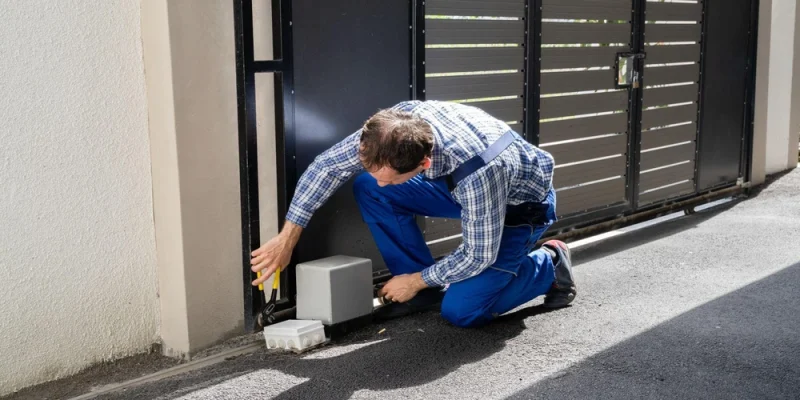
Image Recommendation: A technician inspecting the motor unit of a sliding auto gate at a residential driveway, daylight.
“It was working yesterday.” That’s the sentence almost every auto gate repair call starts with, and it’s rarely as mysterious as it feels standing in the driveway wondering why the remote suddenly does nothing. Auto gates don’t usually fail out of nowhere. They fail after weeks of small warning signs nobody was quite looking for.
A Quick Diagnostic Before You Call Anyone
Different symptoms tend to point toward fairly specific causes, worth knowing before assuming the worst:
| What You’re Seeing | Likely Cause | Typical Fix |
| Gate doesn’t respond to the remote at all | Dead battery, remote sync issue, or motor control board fault | Battery swap or resync; board inspection if that doesn’t resolve it |
| Gate moves slowly or struggles partway | Track obstruction or misalignment | Clear and realign the track; check rollers and hinges |
| Gate makes grinding or straining noises | Worn motor components or lack of lubrication | Motor servicing, part replacement if wear is significant |
| Gate reverses or stops mid-cycle | Sensor misalignment or safety cut-off triggering | Sensor recalibration or replacement |
None of this replaces an actual inspection, but it’s usually enough to know roughly what you’re dealing with before a technician even arrives.
Why ‘It Just Stopped’ Rarely Means What It Sounds Like
A gate that suddenly stops responding almost always had a build-up phase, a slightly slower swing, an occasional hesitation, a noise that got dismissed as nothing in particular. By the time it stops entirely, the underlying issue has usually been developing for a while, which is exactly why sudden failures often trace back to something that was quietly worsening for weeks.
Paying attention to those early signs, rather than waiting for the gate to stop entirely, is usually the single easiest way to turn an emergency call-out into a routine, cheaper fix.
The Usual Suspects Behind a Gate That Won’t Budge
Track obstructions, motor wear, and misalignment account for the overwhelming majority of issues technicians actually encounter on site. Reliable auto gate repair in Singapore starts with correctly identifying which of these is actually responsible, since treating a misalignment issue as a motor problem, or vice versa, wastes both time and money without solving anything.
Weather plays a role too, particularly for outdoor installations exposed to Singapore’s humidity and heavy rain, which accelerates wear on components that aren’t properly weatherproofed.
Why Some Gates Break Down Far More Often Than Others
Not every auto gate ages at the same rate. Build quality, installation precision, and how well a system was matched to the gate’s actual weight and usage pattern all affect how often it ends up needing attention. A system installed slightly undersized for a heavy gate will show wear years before an appropriately matched one ever would.
Choosing a System That’s Actually Built to Last
Getting the initial installation right matters more than most homeowners realise when comparing quotes on price alone. A properly specified auto gate system in Singapore accounts for gate weight, usage frequency, and local weather conditions from the outset, which tends to prevent a meaningful share of the repair calls that undersized or poorly matched systems generate down the line.
What Regular Maintenance Actually Buys You
A brief service check every so often, catching a loose bolt, a track that needs clearing, a sensor slightly out of alignment, tends to be considerably cheaper than waiting for a full breakdown. Most of the emergency repair calls technicians see could have been caught earlier with a routine look rather than addressed only once the gate had already stopped moving entirely.
The gate that suddenly won’t open rarely broke suddenly. It just finally reached the point where a small, ignorable problem became one that stopped you in the driveway. Catching it earlier is almost always cheaper, and considerably less inconvenient, than catching it at the point it finally gives out.
Gate acting up, or thinking about installing one that won’t? Contact San Automation Gate for a proper inspection or quote.









Comments