
 By
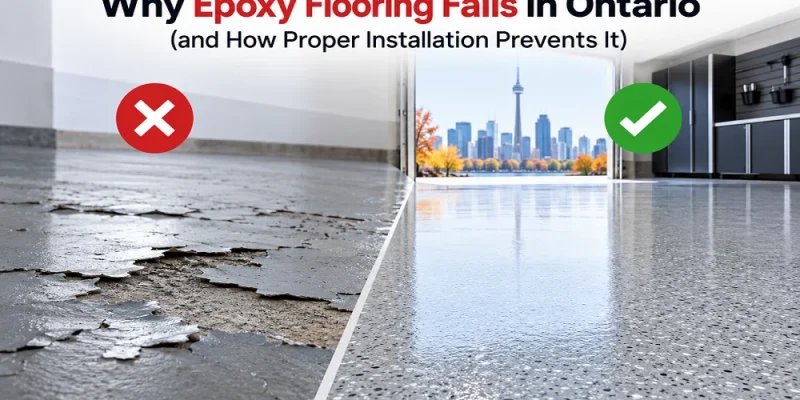
Ontario concrete has a hard life. Road salt rides in on tires, freeze-thaw cycles open hairline cracks, and basements fight moisture all year. Epoxy flooring protects a slab from all of that, yet plenty of owners have watched a fresh floor peel, bubble or flake within a couple of years.
The coating is rarely to blame. Whether epoxy flooring in Toronto lasts a few seasons or a couple of decades usually comes down to what happens before any resin is mixed. Here is what separates floors that last from floors that fail.
Why Epoxy Flooring Fails: Poor Concrete Preparation
Epoxy bonds to concrete both chemically and mechanically, and that bond is only as good as the surface underneath. If the slab is contaminated with oil, sealed under an old coating, damp, cracked or too smooth, the new coating has nothing solid to grip.
Three culprits show up again and again:
- Weak mechanical preparation. A quick scrub or acid etch doesn’t create the surface profile a coating needs. Diamond grinding does.
- Unaddressed moisture. Without testing, and a moisture-mitigation primer where needed, vapour pushes the coating off the slab from below.
- Skipped repairs. Cracks, pits and spalled patches that are coated over show through the finish and tend to widen.
Toroo Coatings provides epoxy flooring in Toronto and the GTA, with over 10 years of experience installing epoxy, metallic, flake, quartz, polyaspartic, polyurethane and urethane cement floors, plus acrylic, PU and CushionX sports courts. Get a free quote today.
Concrete Preparation for Epoxy Flooring: The 4-Step Process
A reputable installer follows a sequence, not a shortcut. At Toroo, based in Richmond Hill and serving the GTA and Southern Ontario, every installation begins the same way:
- Concrete assessment. The slab is inspected for moisture, structural cracks, existing coatings and contamination before any work starts.
- Diamond grinding. Industrial grinding removes old sealers and creates the ideal profile for adhesion.
- Crack and surface repair. Cracks, chips, pits and spalled concrete are repaired and levelled into a sound base.
- Coating installation. Only now does the epoxy, polyurethane or other system suited to the space go down.
The coating itself is step four. Spending more time on the first three is what keeps a floor from peeling, bubbling or delaminating.
Choosing the Right Epoxy Flooring in Toronto for Your Space
There is no single best coating, only the right one for the job.
Epoxy Garage Floor Coatings
Salt, oil, chemicals and hot tires are the enemy. A hybrid system, with an epoxy base for thickness and a polyaspartic topcoat for UV resistance and faster curing, handles them well. Decorative flakes add texture and hide minor imperfections.
Basement and Metallic Epoxy Floors
Seamless, moisture-resistant finishes resist mold and bacteria and clean up easily. Metallic epoxy creates marble-like patterns that suit basements, studios and showrooms.
Commercial Epoxy Flooring for Kitchens and Warehouses
Urethane cement systems suit wet, hygienic kitchens and food production. They resist thermal shock, offer slip resistance and are easy to sanitise. For warehouses and factories, an epoxy base with a polyurethane topcoat adds impact resistance for forklift traffic and abrasion.
Sports Court Flooring: Acrylic, PU and CushionX
A court is not a garage floor. Acrylic suits outdoor tennis and pickleball, polyurethane suits indoor and high-use facilities, and cushioned systems such as CushionX use rubber-based layers under the acrylic top coat to reduce joint impact. Toroo installs the surface, fencing and line marking as one project, so owners aren’t coordinating several trades.
8 Questions to Ask Your Epoxy Flooring Contractor
A good contractor welcomes these questions. A vague answer tells you something too.
- How will you prepare the slab? Diamond grinding or shot blasting is the right answer. “We’ll clean it well” is not.
- Will you test for moisture and repair cracks first? Both should be part of the quote.
- Which system do you recommend, and why? The answer should reference your traffic, chemicals and sanitation needs.
- Is the cost of epoxy flooring in Toronto itemized? Pricing depends on floor condition, repairs, the system and decorative options. Residential garage floors in the GTA are commonly quoted at $4 to $7 per square foot. Insist on clear, upfront numbers with no hidden costs.
- What is the real timeline? Each coat typically needs 8 to 24 hours to cure, light foot traffic is usually possible after 24 to 48 hours, and vehicles can take 5 to 7 days.
- Can you work around my operations? For businesses, nights, weekends and phased installs keep part of the floor usable.
- What does the warranty cover? Get it in writing.
- Can one team handle the whole job? Cove base, wall painting, storage or court fencing are easier from a single contractor.
Epoxy Floor Resurfacing: Repair Before You Replace
Not every floor needs a full rebuild. Peeling topcoats, visible cracks, pooling water or faded markings often mean a floor can be restored. A proper resurfacing job includes a condition assessment, crack and base repair, removal of failed layers, a fresh coating system and new line markings. It is usually faster and more economical, as long as the base is sound.
Final Thoughts on Epoxy Flooring in Toronto and the GTA
A well-installed epoxy or polyurethane floor is one of the most durable, low-maintenance surfaces you can put on concrete. Choose a contractor who talks about preparation first, matches the system to your space, and puts clear pricing and timelines in writing.





Comments